A couple of days ago, I found my old physics books and decided to remember the good ol’ days and while doing so, I found a problem I proposed for the Salvadoran Physics Olympiad and wanted to share the solution. I will try my best to properly translate it to English.
Problem
In outer space, where gravity can be discarded, Bobby takes the cannon that Nacho gave him as a birthday present. There he sees a glass sheet at a distance $l$. Behind the first glass sheet, there are an infinite number of glass sheets and the distance between them gets reduced by 2 as seen in the image below.
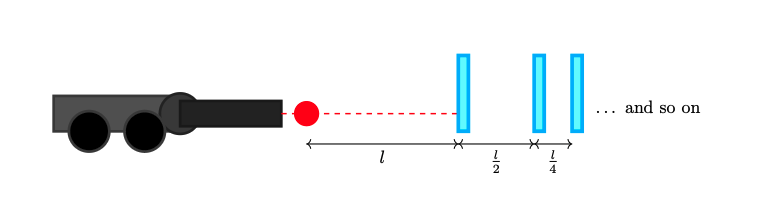
Bobby ignites the cannon and the ball hits the glass sheet. The glass sheet breaks and the ball bounces back toward the cannon. Assume that throughout this process, no energy is lost, momentum is conserved and the mass of the glass sheet is insignificant compared to the ball. This process continues until it breaks $n$ glass sheets. Bobby asks himself:
- What is the position of the ball when it reaches the $n^{\text{th}}$ sheet?
- What is the distance the ball has traveled when it reaches the $n^{\text{th}}$ sheet?
- What is the time taken to reach the $n^{\text{th}}$ sheet? Assume an initial velocity of $v$.
Solution
First problem
Let’s assume that when the ball hits the first glass sheet, it’s in position $(0, l)$. Thus, $p_1 = (0, l)$. If we extrapolate this behavior we can see that:
$$p_2 = \left( 0, l + \frac{l}{2} \right)$$ $$p_3 = \left( 0, l + \frac{l}{2} + \frac{l}{4} \right)$$ $$p_4 = \left( 0, l + \frac{l}{2} + \frac{l}{4} + \frac{l}{8}\right)$$ $$\dots$$
We see that this is just a geometric series, and thus, we can generalize this to:
$$ p_n = \left( 0, \sum_{k=0}^{n-1}l \left( \frac{1}{2}\right)^k \right) = \left( 0, l\frac{1 - \bigl(\tfrac12\bigr)^{n}}{1 - \tfrac12} \right) = \left( 0, 2l\Bigl(1 - \frac{1}{2^{n}}\Bigr) \right), \qquad n\ge1. $$
Second problem
This one is very similar to the first part, with the difference that the distances keep adding up. The ball is first launched and it travels a distance $l$ towards the first glass sheet and another $l$ back to the cannon. Then, it goes back to hit the second glass sheet and it travels an extra distance $l + l/2$, and the overall distance would be $l + l + l + l/2 = 3l + l/2$. If we continue this process, a very interesting pattern appears:
$$ d_n = d_{n-1} + 2d_{n-1} + \frac{\ell}{2^{n-1}} = 3d_{n-1} + \frac{\ell}{2^{n-1}}, \qquad d_1 = \ell. $$
It doesn’t take long to solve, and the final result I got was:
$$ d_n = \frac{2l}{5} \left( 3^n - \frac{1}{2^n} \right) $$
Just a quick sanity check: $$ d_1 = \frac{2l}{5} \left( 3^1 - \frac{1}{2^1} \right) = \frac{2l}{5} \left(3 - 0.5\right) = \frac{2l}{5} \cdot 2.5 = l $$
$$ d_2 = 3d_1 + \frac{l}{2^{2-1}} = 3l + \frac{l}{2} = \frac{7l}{2}, \quad \text{and} \quad \frac{2l}{5} \left(3^2 - \frac{1}{2^2}\right) = \frac{2l}{5} \left(9 - 0.25\right) = \frac{7l}{2} $$
Third problem
Given the distance found in problem 2, we can find the time taken to reach the $n^{\text{th}}$ sheet by dividing distance by velocity. We can do this because we assumed that no energy was lost during collisions and the velocity remains the same. Thus:
$$ t_n = \frac{2l}{5v} \left( 3^n - \frac{1}{2^n} \right) $$
And just for the heck of it, how about now we assume that the collisions are no longer elastic and after each collision, the velocity is reduced $\eta$ times. If you send me the solution for this problem, 삼겹살 is on me.